For 25 years, Google Search has worked pretty much the same way.
You typed a few words. You got a list of links. You clicked. Read the content and got your answer.
At its May 2026 I/O developer conference, Google announced what it called the biggest upgrade to Search in more than 25 years.
Google search is shifting to AI-powered interactive experiences that answer questions directly, search on your behalf, and increasingly keep users inside Google from start to finish.
Why it matters: How your potential clients find you, research you, and decide whether to contact you is changing.
This article breaks down:
Google Has Changed the Rules Before
This isn’t the first time Google has rewritten what it means to “show up” in search. A quick look at some of Google’s notable search changes:
- 2004: Google Suggest (Autocomplete) altered search behavior by predicting search queries as users typed.
- 2007: “Universal Search” expanded on the standard “10 blue links” by including news, images, local maps, and videos into the main results page.
- 2012: Google’s “Knowledge Graph” was the first shift towards an entity-based “answer engine” by displaying immediate facts, dates, and entities in the right-hand panel (e.g., details about a celebrity or landmark).
- 2015: The RankBrain algorithm update introduced deep machine learning to interpret never-before-seen queries, helping the search engine better understand search intent.
- 2023–2024: Search Generative Experience (SGE), introduced at Google I/O 2023, became AI Overviews and rolled out to all U.S. users in May 2024.
- May 2026: Google introduces the interactive “intelligent search box” and other AI search features at the 2026 Google I/O conference.
Every few years, Google changes what it means to get found online. These latest updates aren’t the first time Google has inserted AI into search.
Go deeper: A timeline of Google’s 25 biggest changes
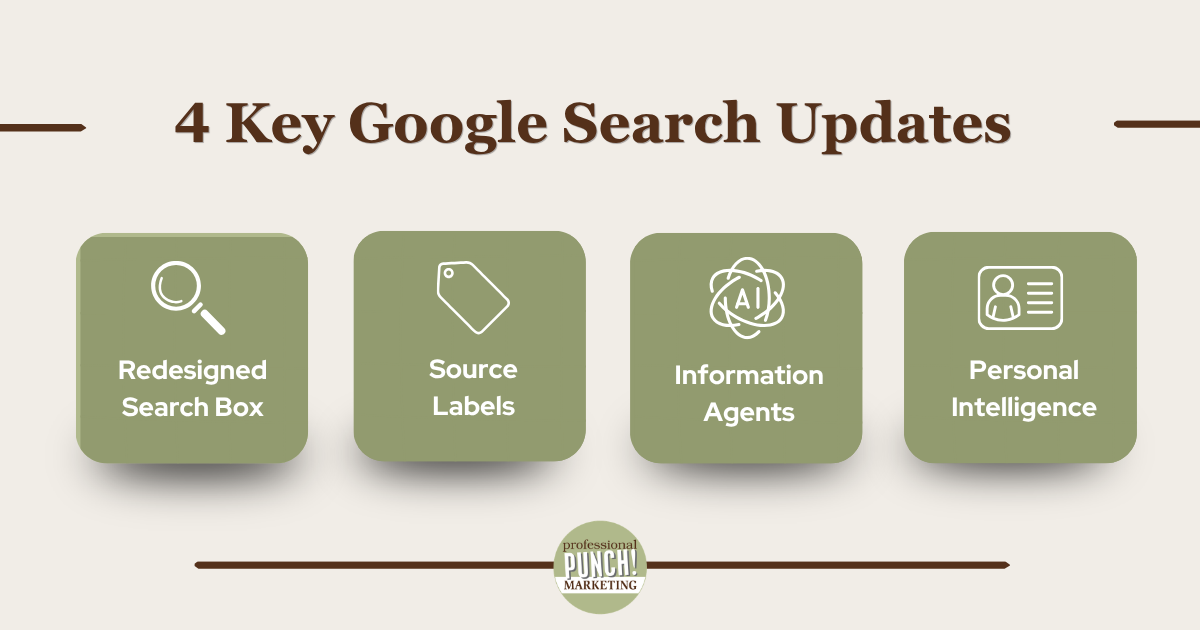
Four Google Search Updates From the I/O 2026
1. The search box was redesigned
- The search bar expanded to accommodate longer, more conversational queries.
- Users can search using text, images, files, videos, or open Chrome tabs as inputs.
- Ask follow-up questions directly in AI Overviews (using AI Mode) for a conversational back-and-forth search style.
What it means for B2B: Potential clients search with details about their business, needs, and the solution or service they’re looking for. Your content needs to be specific and relevant to their queries to be surfaced in search results.
2. “Preferred Sources” and “Highly Cited” labels reward credible content
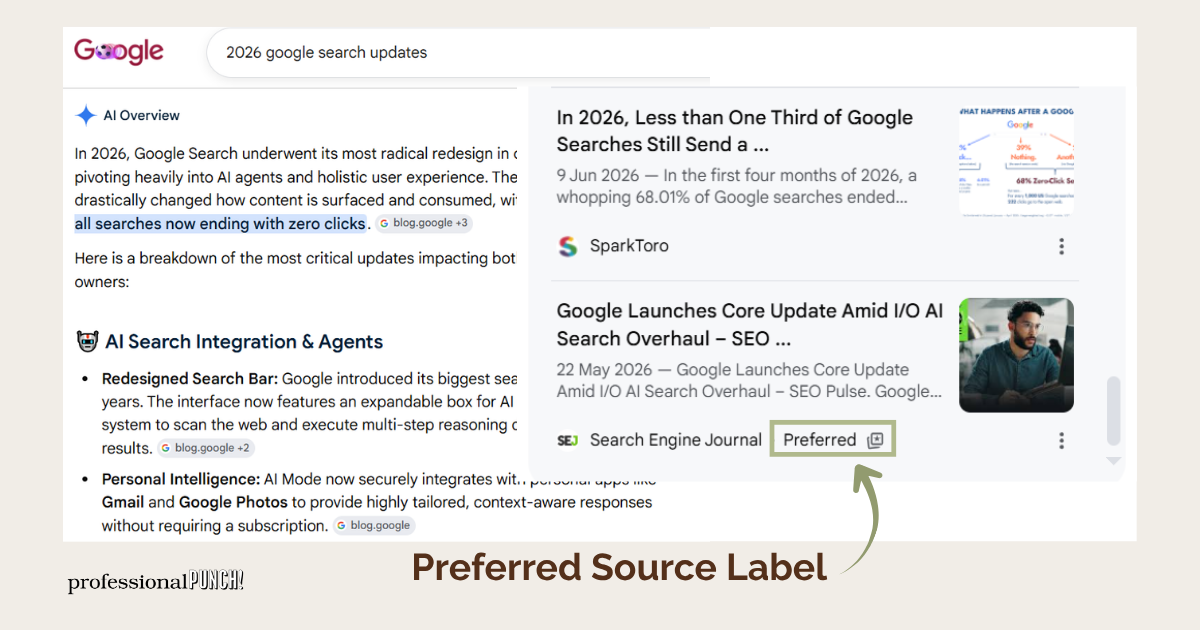
- Users can designate specific websites as “Preferred Sources” in their search settings. Content from Preferred Sources will appear in AI Overviews, AI Mode answers, and Top Stories with a “Preferred Source” label.
- Content from a user’s Preferred Sources is more likely to be surfaced in search results.
- Google is also adding a “Highly Cited” badge to article links in search results, identifying articles that many other publications have cited and helping users find credible reporting on a topic.
What it means for B2B: Google is actively rewarding content that earns trust signals, such as citations from other publications, links from authoritative sources, and direct user preference.
Being an original, credible source on a topic in your industry is no longer just good practice. It is increasingly how you get surfaced.
3. “Information Agents” that search on your behalf
New AI “information agents” allow users to automate web monitoring and research for specific topics, receiving synthesized updates instead of manually searching.
Example: A CFO looking for accounting software asks an agent to compare the top options for a 50-person company, summarize pricing tiers, and identify which platforms have the strongest reviews from finance teams. The agent handles the entire research phase.
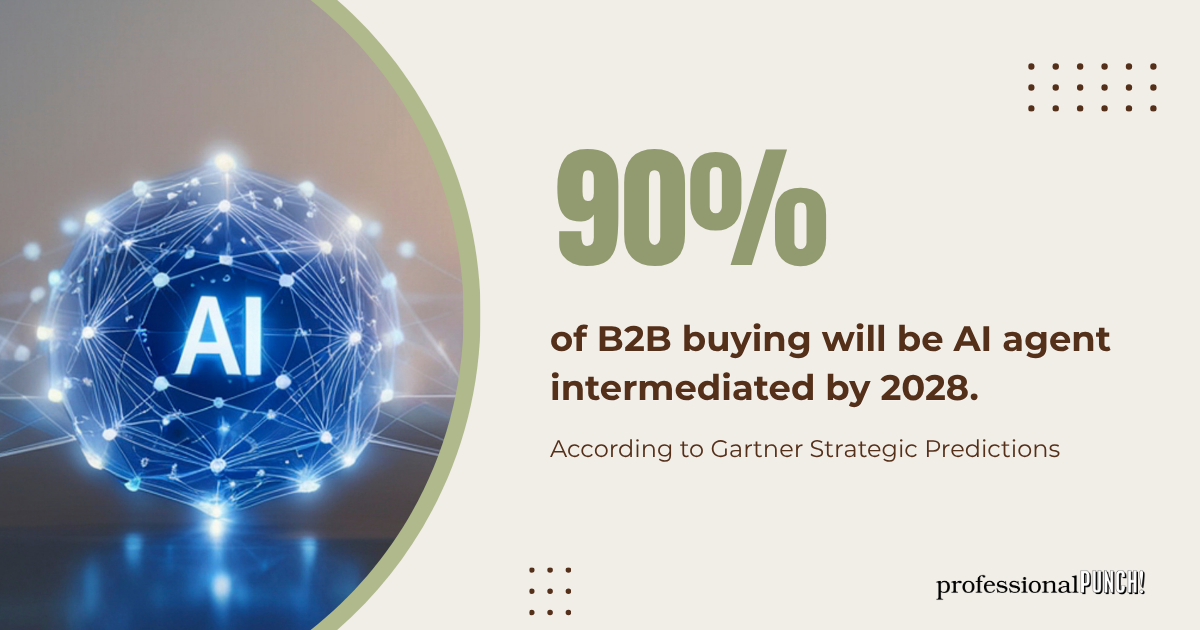
What it means for B2B: By the time a human is involved, the consideration set is already formed, and your brand is either in it or it isn’t.
4. Personal Intelligence: Search now knows your context
Google is expanding Personal Intelligence in AI Mode, allowing users to securely connect apps like Gmail, Google Photos, and Google Calendar.
Search can then use that personal context to inform answers.
What it means for B2B: Your past proposals, email threads, and follow-up communications will become part of the search experience. Staying in contact with prospects isn’t just good relationship management. It’s a visibility strategy.
Go deeper: Read more about these changes in Google’s full I/O 2026 Search announcement.
Reaction to Google’s Changes
What Do Search Users Think?
More than one-third of consumers now say they begin their searches with AI tools rather than traditional search engines. They describe AI results as faster, simpler, and less cluttered.
Trust is not automatic, though. Nearly half of consumers will look for confirmation after seeing an AI answer. When they verify, reviews are the signal they trust most.
Not Everyone is on Board.
The reaction to the I/O 2026 changes was immediate.
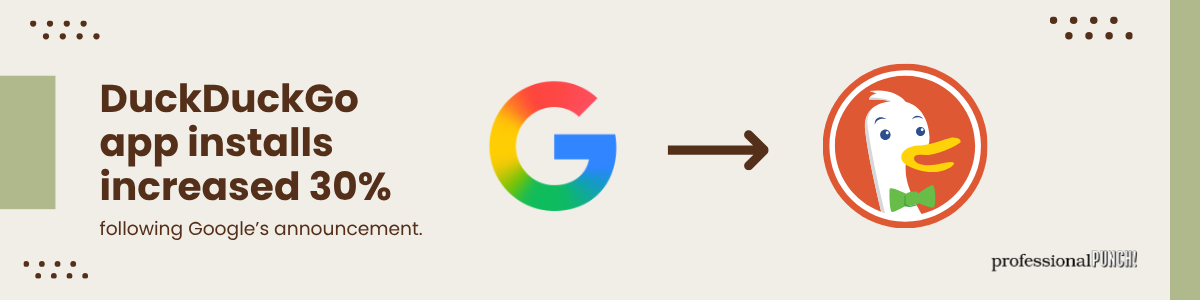
In the week following Google’s announcement, DuckDuckGo app installs spiked 30%, and visits to their dedicated “No AI” search page tripled as users sought an alternative that did not “force” them to use AI.
What Do Website Owners Think?
Many website owners dislike the changes because they keep more of the search journey within Google, which affects CTR (Click-Through-Rate) and website traffic.
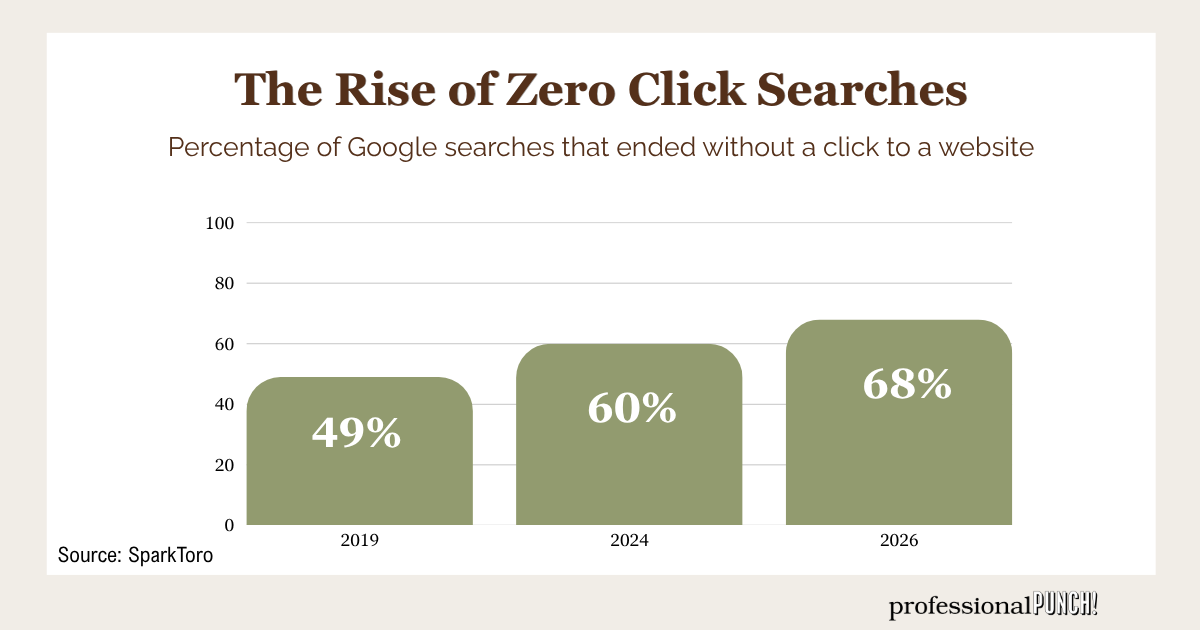
We are seeing the fastest acceleration of the “zero click” trend in a decade, driven largely by the growth in AI Overviews and the increased use of AI Mode and AI agents.
- In 2019, SparkToro first reported that 49% of Google searches ended without a click.
- By 2024, that figure had grown to 60%.
- In the first four months of 2026, it reached 68%.
If users are getting their answers on the results page, they are not clicking through to websites.
It’s NOT all doom and gloom.
- Google’s expansion of Preferred Sources means users who already trust your brand are now twice as likely to click your links when they appear in AI answers.
- The new “Highly Cited” badge rewards original content that other publishers reference with a visible credibility signal directly in search results.
For businesses investing in content quality and audience trust, these features are a meaningful counterweight to the zero-click trend.
What Should You Do About These Changes?
You are already ahead if you have a content and/or SEO strategy. The foundations of traditional SEO (like authoritative content, topical depth, and quality backlinks) are the same foundations that get you cited in AI answers.
Whether you’re starting from scratch or building on what you have, here are six things we recommend doing to stay visible as search continues to evolve.
Six Practical Starting Points
- Write content that answers the questions your customers are already asking.
- Think about what comes up on client calls, in sales conversations, at networking events, and in form submissions.
- Create content that answers those questions.
- Write for a specific person with a specific problem, not only for a keyword.
- AI surfaces content that fully and clearly answers a question.
- Create content AI can’t generate itself.
- Generic content is largely invisible now.
- What earns citations: your unique point of view, interviews with subject matter experts, proprietary data or original research, custom graphics and videos, and client case studies.
- Be visible across multiple channels.
- Rand Fishkin’s advice for the zero-click era: invest in marketing on platforms you don’t own or control, and promote your brand where your audience pays attention.
- LinkedIn, YouTube, Reddit, industry publications, review platforms, media outlets, and third-party directories all matter.
- AI systems draw from what’s visible and credible across the web, not just your own site.
- Actively request reviews and Preferred Source designation.
- Keep your Google Business Profile current.
- Build a consistent process for requesting reviews after positive client interactions.
- Request clients, email contacts, newsletter subscribers, LinkedIn followers, etc., to add you as a Preferred Source – here’s how.
- Build topical depth on your website.
- Websites that consistently cover a topic in depth build topical authority.
- AI looks for you to cover your core topic from multiple angles: the problem you solve, how you solve it, who you solve it for, and what results clients can expect.
- Think beyond service pages!
- For example, blog posts that answer client questions, case studies that show your process, FAQ pages built from real conversations, and a LinkedIn article that explains your methodology.
- Expand what you measure.
- Traffic alone is a misleading metric in an AI-forward, zero-click world.
- Additional KPIs worth measuring alongside traffic:
Branded search volume (are more people searching for you by name?)- Direct traffic (are people coming to you without a search prompt?)
- Lead quality and conversion rate (is the traffic you do get turning into clients?)
- AI citation visibility (is your brand appearing in AI Overview answers for your key topics?)
- Referral traffic from third-party sources (publications, directories, review sites)
The Bottom Line
The search experience and search behavior are changing fast.
The businesses that will hold their ground are the ones that:
- Show up where buyers are paying attention.
- Create content that answers audience questions.
- Are visible across multiple channels.
- Have credibility that AI systems and buyers alike see as a source worth referencing.
If you want help understanding what this shift means for your company’s website and content strategy, that’s a conversation we’d love to have.
Reach out to us at info@professionalpunch.com to schedule a consultation.